News
Your Trainee APTs Need You! – A Call for External Assessors
Tarot Harris-Noble FAAPT presented at the AAPT Annual Educational Event (AEE) on the 26th September
At the AAPT Annual Educational Event (AEE) in Sheffield on Saturday 26 September 2026, Tarot Noble BSc FAAPT, Education & Professional Standards, AAPT delivered a rallying call for experienced Anatomical Pathology Technologists (APTs) to consider becoming external assessors for the Level 3 Diploma in Healthcare Science (Anatomical Pathology Technology).
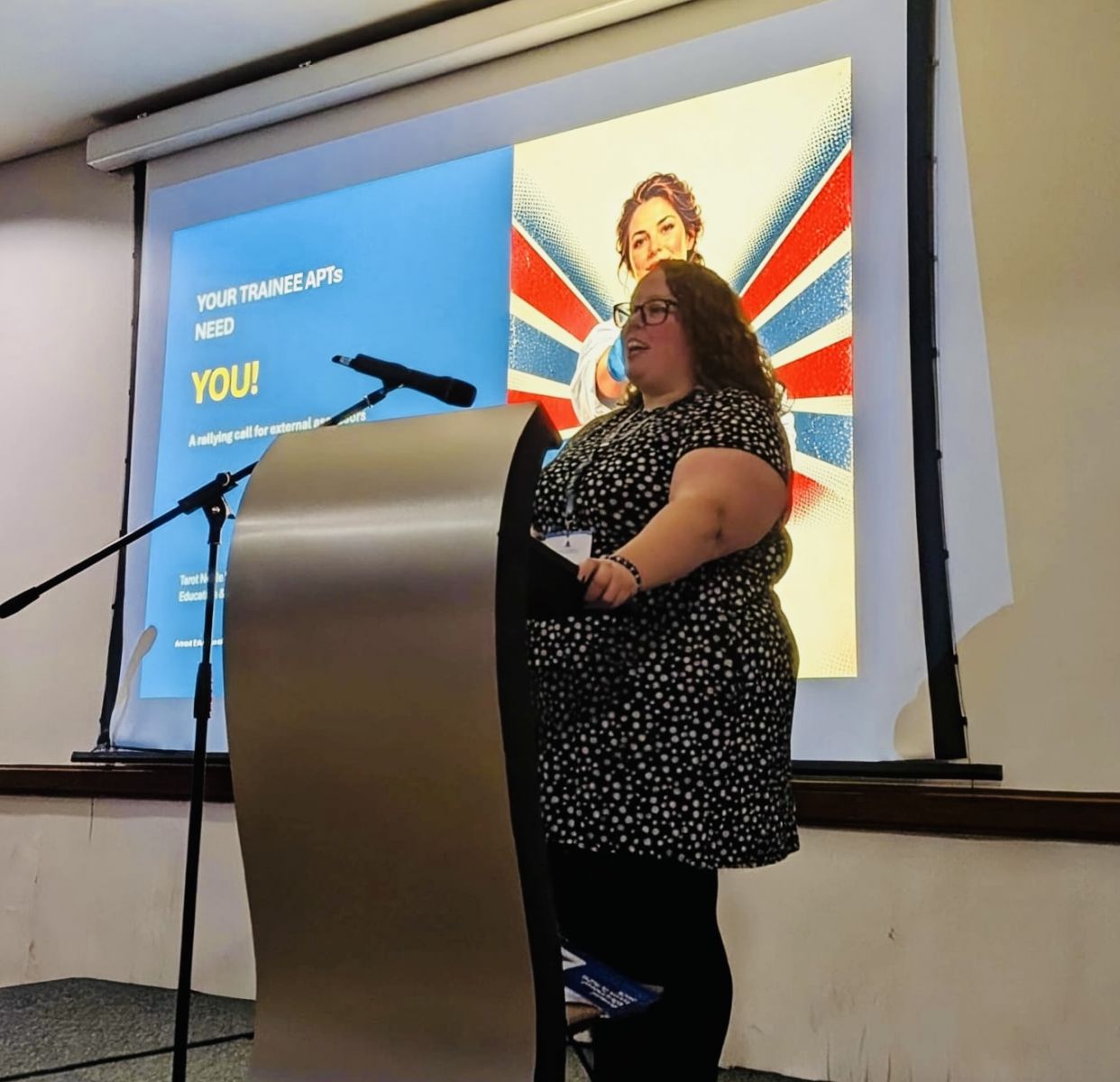
“Your Trainee APTs Need YOU!” was the title of Tarot’s presentation, which explored the growing need for external assessors and how experienced APTs can support the next generation of the profession.
The current picture
Tarot shared the current assessor and trainee figures with delegates at the AEE. There are currently six active assessors covering 17 trainees, while a further eight trainee APTs are currently without an assessor.
The message was clear: while AAPT is extremely grateful to the existing assessors for the significant contribution they make, a sustainable system cannot rely on a small number of individuals.
External assessors play an important role in ensuring that trainees are assessed consistently and fairly against the required practical standards, wherever they train.
What does an external assessor actually do?
During her presentation, Tarot was keen to demystify the role and address some of the concerns that potential assessors may have.
- Observe practical competence against the published standards.
- Make an evidence-based assessment decision.
- Ask questions where necessary to test underpinning knowledge.
- Provide clear and professional feedback.
- Support consistency in APT practice nationally.
The role is not about trying to catch trainees out, imposing one particular local way of working, or expecting every mortuary to operate identically. As Tarot explained to delegates, good assessors are fair, consistent and evidence-led.
What is assessed?
The Level 3 practical assessment includes a number of important areas of APT practice, including:
- APT3.6 – Assist with post mortem examinations
- APT3.7 – Preparation and operation of a mortuary
- APT3.8 – Prepare for post mortem examinations
- APT3.9 – Team working
- APT3.11 – Viewing of the deceased
AAPT advises that each trainee should normally require no more than one or two days of external assessment.
What happens during an assessment visit?
Tarot also took delegates through what an assessor visit actually involves. The process can be broken down into five stages:
Prepare – understand the standards and plan the visit.
Observe – watch the trainee undertake real practical tasks in their home mortuary.
Probe – ask focused questions where clarification is needed.
Decide – make an assessment decision based on the evidence demonstrated.
Feedback – explain what has been demonstrated and clearly document the outcome.
The aim is not to make the trainee perform for the assessor, but to provide a fair opportunity to demonstrate competence.
Why become an external assessor?
The presentation also explored what assessors themselves can gain from taking on the role. External assessing provides opportunities for:
- CPD – assessor activity is recognised as valuable continuing professional development.
- Perspective – visiting other mortuaries provides an opportunity to see different approaches and reflect on your own practice.
- Assessment skills – develop observation, questioning, feedback and professional judgement.
- Professional contribution – help support the next generation of APTs and maintain practical standards.
- Networking – build relationships with trainees, mentors, managers and assessors across the profession.
Could you become an assessor?
For delegates wondering whether they might be eligible, Tarot outlined the current requirements. These include:
- AAPT Member class or Fellow class
- The RSPH Diploma / Level 3 Diploma with at least two years' post-qualification experience, or the Level 4 Diploma.
- Professional registration with the Science Council or Academy for Healthcare Science.
- Attendance at an External Assessor Awareness event.
- External assessment of your own practical post mortem skills.
For those who are not quite there yet, Tarot encouraged delegates to consider the process as a series of manageable steps: check, register, learn, demonstrate and then assess.
Your next opportunity – External Assessor Awareness Event
For delegates who left the AEE thinking “I'd like to understand more about this”, there is already an opportunity to take the next step.
Friday 23 October 2026
IBMS, London
Free for AAPT Members and Fellows | Limited to 30 delegates
The day will cover:
- Practical assessment standards
- What actually happens during an assessor visit
- Professional registration pathways through the Science Council and AHCS
- How to become an assessor
Find out more and book your place: https://www.aaptuk.org/link/events/2026/10/23/level-3-external-assessor-awareness-event-october-2026
Supporting the future APT workforce
Tarot’s presentation was ultimately a call to action for the whole profession.
For individual APTs, that might mean checking whether you already meet the requirements, working towards professional registration, attending an awareness event or simply finding out more about what the role involves.
For managers, it means considering how staff can be supported with professional development, registration and protected time to undertake assessor activity.
AAPT is also looking at further practical assessor development opportunities around the country, building on the successful Bristol “Assess the Assessor” activity and with planned activity in Bristol, Hull and Suffolk during 2027.
“Your trainee APTs still need you.”
Could you be the next AAPT external assessor?
Find out more about the external assessor role:
https://www.aaptuk.org/professional-support/external-assessors-for-the-level-3-diploma-in-healthcare-science-in-anatomical-pathology-technology